


7 óra ezelőtt

Free Download Schrodinger Suites 2026-4 Advanced Version with Documentation | 33.8 Gb
Schrödinger Suites is a comprehensive collection of scientific software designed for computational chemistry, molecular modeling, drug discovery, and materials science research. Developed by Schrödinger, the suite provides specialized tools for investigating molecular structures, predicting interactions, analyzing chemical properties, and designing new compounds.
The platform combines a graphical working environment with advanced computational engines and specialized scientific applications. Its tools support workflows ranging from protein preparation and ligand docking to molecular dynamics, free-energy calculations, quantum mechanics, and machine learning-based materials research.
The 2026-4 release introduces improvements across life science and materials science workflows, including enhanced Maestro integration, faster molecular screening, expanded molecular dynamics capabilities, GPU-accelerated quantum calculations, and additional AI and machine learning functionality.
Software Overview
Schrödinger Suites brings together a broad range of computational tools for researchers working in pharmaceutical development, chemical sciences, biotechnology, and materials engineering.
The Maestro graphical interface serves as the central environment for preparing molecular structures, managing projects, configuring calculations, and analyzing results. Integrated applications such as Glide, Desmond, Jaguar, LigPrep, Prime, MacroModel, Epik, and SiteMap provide specialized capabilities for different stages of scientific research.
The suite also includes materials science applications for quantum calculations, molecular dynamics, transport properties, materials informatics, and computational modeling.
Key Features
- Maestro Graphical Environment: Prepare, visualize, organize, and analyze molecular structures through an integrated scientific interface.
- Molecular Modeling: Build, edit, and refine molecular structures for computational research.
- Protein Preparation: Configure hydrogen placement, bond orders, terminal groups, and other structural details before downstream calculations.
- Molecular Dynamics: Simulate molecular behavior using Desmond and supported system-building workflows.
- Ligand Preparation: Prepare ligand structures and generate conformations for molecular modeling and screening.
- Molecular Docking: Investigate ligand binding poses and perform virtual screening with Glide.
- Free Energy Calculations: Use FEP+ and related workflows to investigate binding affinity and molecular interactions.
- Quantum Mechanics: Perform electronic structure calculations, energy evaluations, and geometry optimizations with Jaguar and other supported tools.
- Materials Science: Explore material properties, molecular interactions, surface structures, and transport behavior.
- Machine Learning: Apply machine learning models to molecular design, property prediction, and materials research.
- Scientific Visualization: Inspect molecular structures, simulation results, and computational data.
- Research and Education Resources: Access tutorials and learning materials covering life science and materials science workflows.
The 2026-4 release delivers updates across the platform environment, target validation, molecular analysis, ligand preparation, virtual screening, lead optimization, and materials science.
Platform Environment and Maestro
- Bunsen-Maestro Integration: Launch Maestro and Bunsen from each other's interfaces and connect active sessions.
- Automated Dialog Handling: Improve agentic workflows by automatically handling modal dialogs that could otherwise interrupt execution.
- Faster LiveDesign Export: Significantly accelerate exports from Maestro to LiveDesign. For approximately 75,000 compounds, the reported processing time has been reduced from around one hour to under four minutes.
- Improved Residue Grouping: Organize non-standard and modified residues within their parent protein, DNA, or RNA chains in sequence order.
- Pinned Projects and Structures: Keep favorite projects and structures accessible from the Maestro Welcome Screen.
- Reset UI Preferences: Restore default window layouts, toolbars, colors, fonts, and presets without changing project files or scientific options.
- Improved 2D Viewer Controls: Configure persistent 2D display settings independently of global preferences and access an option to expose all hydrogens.
- Native Apple Silicon Support: Use native ARM64 binaries across the macOS suite without relying on Rosetta 2 translation.
- Protein Preparation: Customize hydrogen and bond-order assignment settings more easily.
- Interactive Terminus Capping: Apply terminal capping during protein preparation.
- Terminal Oxygen Reconstruction: Rebuild either terminal oxygen when it is missing from an input structure.
- Predictive Tox Panel: Add progesterone, CB1, and MALT1 as three new targets.
- DNA and RNA Receptors: Extend Desmond Simulation Interaction Diagram support to nucleotide-based receptors.
- POPE-POPG Bilayer: Add a new membrane bilayer template with a 3:1 composition.
- Hydrogen Mass Repartitioning: Adjust HMR settings to accelerate simulations by up to approximately 66%.
- Additional Lipid Bilayers: Add seven mixed lipid bilayer options to the System Builder.
- Macrocycle Ring Spear Detection: Improve LigPrep by detecting bonds that pass through macrocycle rings, preventing unsuitable conformations from being returned.
- Macro-pKa Reports: Provide an improved HTML report after Macro-pKa calculations.
- Generative Glide: Combine generative AI with physics-based docking to screen extremely large molecular libraries and identify promising candidate compounds.
- Cryo-EM Macrocycle Docking: Dock macrocycles into cryo-electron microscopy density maps through the updated script and graphical interface.
- Preserved Ligand Titles: Retain original input ligand titles in macrocycle docking output poses.
- High-Throughput ABFEP Scan: Screen diverse chemical structures and novel scaffolds with a reported speed improvement of up to five times.
- Flexible Water Models: Allow alternative water models in supported ABFEP workflows.
- Tug Align 2: Make Tug Align 2 the default macrocycle alignment algorithm in the Maestro Ligand Alignment panel.
- Advanced Alignment Controls: Expose additional options for more precise macrocycle ligand alignment.
- RetroSynth Reports: Add cover pages, vector graphics, faster report generation, smaller output files, and all solved synthetic routes rather than only the top 30.
- Custom Vendor Selection: Select vendors before launching RetroSynth calculations.
- Stereochemical Scoring: Account for stereochemical variations in custom chemical stock.
- FEP+ Improvements: Provide representative solvent-leg structures and support nucleotide-based receptors.
- Protein FEP: Add pH-dependent affinity prediction setup and analysis, alongside expanded residue scanning for protein mutations and non-standard amino acids.
- Solubility FEP: Provide a representative structure from the hydration leg.
- FEP+ Protocol Builder: Extend support to nucleotide-based receptors.
- Quantum Calculations: Enable GPU-based DFT single-point energy calculations and geometry optimizations within the resolution-of-identity approximation.
- Optical Rotation: Add wavelength-dependent optical rotation as a property in Jaguar panels.
- Macrocycle Improvements: Introduce an open beta release of Tug Align 2, improve native-like conformer enrichment, update the default implicit solvent model, and reduce memory usage in QM scoring workflows.
- Quantum ESPRESSO: Upgrade the interface to Quantum ESPRESSO 7.6 and add support for Broyden optimization in NEB calculations, 3D-RISM solvation, and slab surface termination selection.
- Defect Properties: Extend Freysoldt defect correction support across operating systems.
- Microkinetics: Introduce multistage workflows for electrocatalysis.
- Active Learning Optoelectronics: Add machine-learning force field support for geometry optimization.
- Reaction Network Viewer: Expand the available energy-related properties.
- KMC Charge Mobility: Improve zero-field mobility predictions.
- Reactive Interface Simulator: Improve Solid Electrolyte Interphase calculations with algorithmic speedups of up to four times.
- Machine Learning Force Fields: Add optimization-path structures, multiple-dataset training, custom MPNICE model initialization, and additional fine-tuning controls.
- Transport Calculations: Support solid-state structures as input for ionic conductivity calculations.
- Coarse-Grained Molecular Dynamics: Improve backmapping, antibody support, trajectory recording, force-field building, and mapping workflows.
- Materials Informatics: Add five inorganic crystal property models, six MPNICE embedding models, parallel MLFF calculations, and non-aqueous molecular solubility prediction.
- Formulation Machine Learning: Add CSV output and individual formulation feature-importance reporting.
- De Novo Molecular Design: Provide access to pretrained REINVENT models and AI-powered inverse molecular design.
- Maestro Builders and Tools: Expand agentic workflow creation, structure building, surface modeling, periodic enumeration, and Meta Workflow support.
- Classical Mechanics: Add MLFF support to additional workflows, multi-GPU mixing enthalpy calculations, improved polymer crosslinking, and restartable umbrella sampling.
- Quantum Mechanics: Expand GPU support, adsorption energy calculations, optoelectronic property analysis, and geometry optimization workflows.
The release also introduces new tutorials and updates to existing learning paths covering molecular modeling, macrocycle optimization, cryo-EM ligand refinement, AI-driven materials workflows, electrocatalysis, machine learning, and computational target analysis.
Upcoming LiveDesign Features
The supplied release information also highlights planned LiveDesign improvements, including:
- Access to Lilly TuneLab and its proprietary AI models for preclinical drug discovery.
- File-based import of biologic entities with metadata editing and updating.
- Import of published small-molecule assay data using SDF, CSV, MAE, or XLSX files.
- A new SAR Analysis Dashboard.
- A System Health Tool for monitoring LiveDesign server load.
- The ability to combine filter elements into groups.
What is Schrödinger Suites used for?
It is used for computational chemistry, molecular modeling, drug discovery, protein-ligand analysis, molecular dynamics, quantum chemistry, and materials science research.
What is Maestro?
Maestro is the graphical interface used to prepare structures, manage scientific projects, launch calculations, and analyze molecular modeling results.
Does Schrödinger Suites support drug discovery workflows?
Yes. Its life science applications support protein preparation, ligand preparation, molecular docking, virtual screening, free-energy calculations, and lead optimization.
Does the 2026-4 release support Apple Silicon?
Yes. The supplied release notes describe native ARM64 binaries across the macOS suite, allowing supported applications and integrated backends to run without Rosetta 2.
Does the suite include materials science tools?
Yes. It includes applications and workflows for quantum calculations, molecular dynamics, materials informatics, transport properties, and computational materials research.
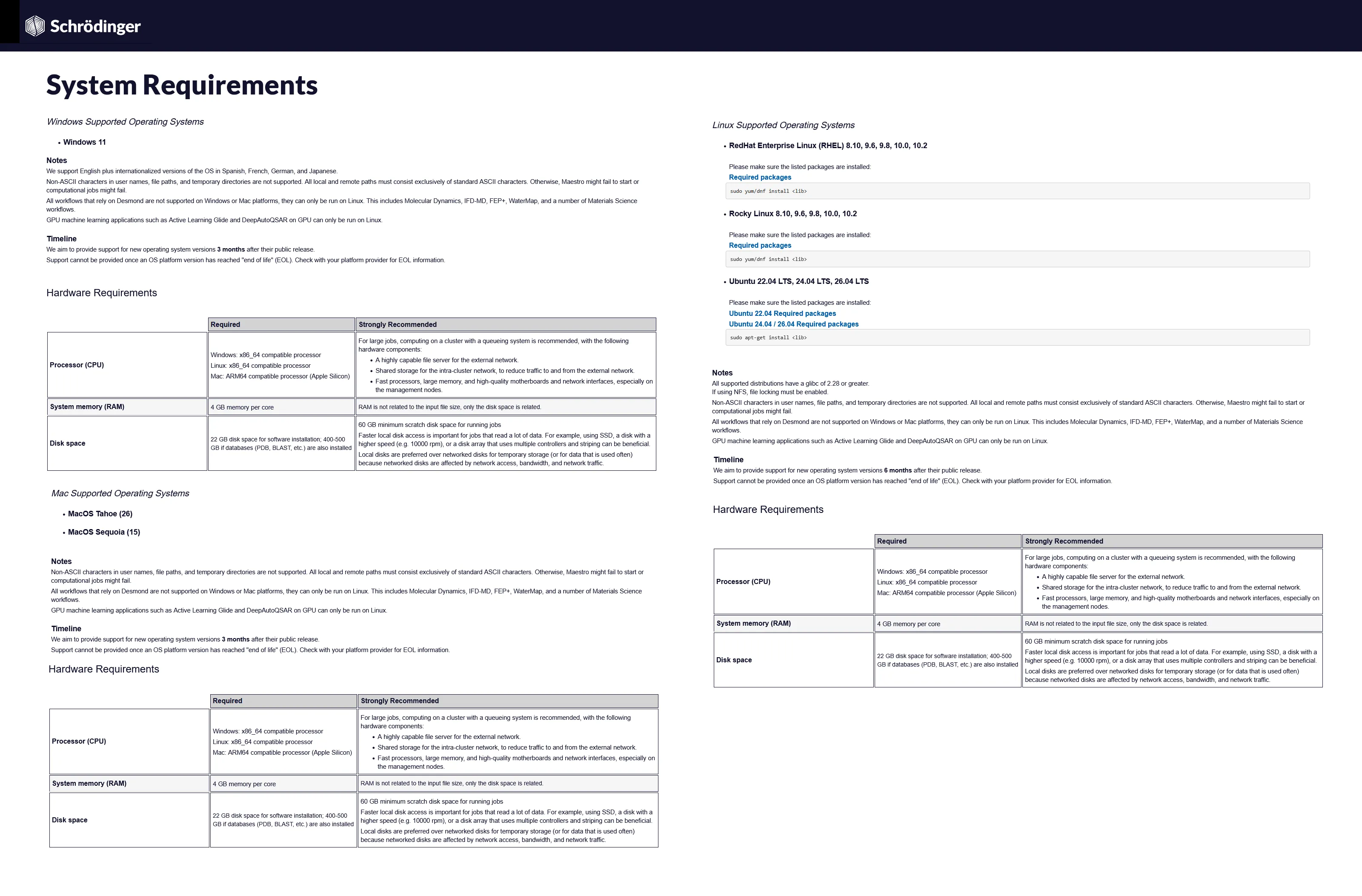
System Requirements
The supplied information lists the following supported platforms:
- Windows
- Linux
- macOS (ARM)
- Architecture: x64
Home Page
Idézet:A kódrészlet megtekintéséhez be kell jelentkezned, vagy nincs jogosultságod a tartalom megtekintéséhez.Program Information
- Software Name: Schrödinger Suites
- Version: 2026-4 Advanced Version with Documentation
- Architecture: x64
- Languages: English
- License Type: Full Version
- File Size: 33.8 Gb
Recommend Download Link Hight Speed | Please Say Thanks Keep Topic Live
Idézet:A kódrészlet megtekintéséhez be kell jelentkezned, vagy nincs jogosultságod a tartalom megtekintéséhez.Links are Interchangeable - No Password - Single Extraction


